Category Archives: windows

Nokia plus Windows Phone 7 – would that be a smart move?

The rumour is that Nokia’s CEO, ex-Microsoft Stephen Elop, is planning a major strategy announcement on Friday February 11. The obvious move would be to embrace a new Smartphone platform, since neither Symbian nor MeeGo look likely to catch up with frontrunners Google Android or Apple iPhone. Could Elop be planning to partner with his former company and embrace Windows Phone 7?

It is a fascinating proposition. Here is the case in favour. For both Nokia and Microsoft, Android is the key competition in this market. The momentum behind Android is deterring both phone manufacturers and operators from investing seriously in Windows Phone 7. Microsoft’s phone is well-regarded, but has made little impact on the general public. Nokia could change that; it could make beautiful Windows 7 phones and get them to the mass market.

Microsoft has also done a good job with the developer tools for Windows Phone 7, with Visual Studio 2010, Silverlight, XNA, and the .NET Framework.

On the other hand, if Nokia were to adopt Windows Phone 7 for its high-end phone platform, would it not alienate its own development community, which is oriented towards Linux and C/C++? I think it would, unless Nokia insisted that as part of its deal with Microsoft, Windows Phone 7 would also support native code development with Qt, Nokia’s cross-platform application framework. This would be great news for Microsoft as well, though it might not recognise it. Windows Phone 7 needs to allow native code development, and Qt is ideal for the purpose. Qt already supports Windows CE, which underlies Windows Phone 7. If Nokia could present Windows Phone 7 as just another platform for Qt, the deal would be palatable for existing Nokia developers.

If Nokia were to announce this, it would transform the prospects for Microsoft’s Smartphone OS as well as helping Nokia to make a renewed impact.

Now for the case against. I am not sure that Qt on Windows Phone 7 would be acceptable to Microsoft, which might prefer to keep developers locked to Visual Studio and .NET; and Nokia has an easy alternative, which is to adopt Android instead. Qt support is still an issue, but there is already an independent project to bring Qt to Android. The combination of the Android and Nokia brands has obvious appeal, whereas taking on Windows Phone 7 would be risky.

The biggest shadow over Windows Phone 7 is cast by Microsoft itself. I do not doubt the commitment of the team which builds it within Microsoft, nor the quality of the developer tools. I do question though whether Microsoft as a whole sees a long-term future for Windows Phone 7 and its “Metro” user interface. The strong hint at CES was that Windows 8, rather than Windows Phone 7, is the basis of Microsoft’s tablet strategy; and if that proves to be the case, then Windows Phone 7 may gradually be displaced. Another puzzle is how Microsoft intends to use “Jupiter”, a rumoured new user interface library for Windows that may well be designed with mobile and touch control in mind. Maybe full Windows with “Jupiter” is the future of Microsoft’s mobile platform, rather than Windows Phone 7? I discuss this in more detail here.

There is enough uncertainty around Windows Phone 7, and enough buzz around Android, that Google’s mobile platform looks to me more attractive than Microsoft’s from Nokia’s perspective. I do not dismiss the Windows Phone idea though; it would be a bold and interesting move.

I expect this post to be very out of date soon, if not by Friday, then certainly by early next week at Mobile World Congress.

Update: A Nokia and Microsoft partnership is looking more likely since Google’s Vic Gundotra tweeted:

#feb11 "Two turkeys do not make an Eagle".

Server admin on the go with Microsoft’s Windows Phone 7 app for SBS 2011

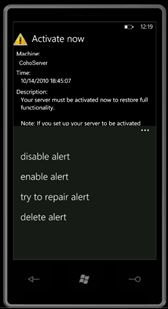
Microsoft has created a Windows Phone 7 app for managing the forthcoming Small Business Server 2011 Essentials.

The app sends alerts to your home page, and lets you perform certain tasks remotely:

  • View storage status
  • View status of connected computers
  • Start PC backup
  • Enable and disable user accounts
  • Reset user password
  • Reboot server

imageimage

A neat feature for simple server admin, and a bit of stealth marketing for Microsoft’s smartphone, which is struggling to make an impact.

I hope the app has some additional security though. Otherwise, a phone thief could cause mayhem with those few features.

Server and Tools shine in Microsoft results – so why is Bob Muglia leaving?

Microsoft released quarterly results yesterday:

Quarter ending December 31 2010 vs quarter ending December 31 2009, $millions

Segment Revenue Change Profit Change
Client (Windows + Live) 5054 -2139 3251 -2166
Server and Tools 4390 412 1776 312
Online 691 112 -543 -80
Business (Office) 5126 612 3965 1018
Entertainment and devices 3698 1317 679 314

Microsoft highlighted strong sales for Xbox (including Kinect) as well as for Office 2010, which it said in the press release is the “fastest-selling consumer version of Office in history.”

Why is Office 2010 selling better than Office 2007? My hunch is that this is a Windows 7 side-effect. New Windows, new Office. I do think Office 2010 is a slightly better product than Office 2007, but not dramatically so. SharePoint Workspace 2010, about which I mean to post when I have a moment, is a big disappointment, with a perplexing user interface and limited functionality.

Windows 7 revenue is smaller than that of a year ago, but then again the product was released in October 2009 so this is more a reflection of its successful launch than anything else.

What impressed me most is the strong performance of Server and Tools, at a time when consolidation through virtualisation and growing interest in cloud computing might be reducing demand. Even virtual machines require an OS licence though, so maybe HP should worry more than Microsoft about that aspect.

I still think they are good figures, and make Server and Tools VP Bob Muglia’s announced departure even more puzzling. Just what was his disagreement with CEO Steve Ballmer?

Server and Tools revenue includes Windows Azure, but it sounds like Microsoft’s cloud is not generating much revenue yet. Here is what CFO Peter Klein said:

Moving on to Server and Tools. For Q3 and the full year, we expect non-annuity revenue, approximately 30% of the total, to generally track with the hardware market. Multi-year licensing revenue which is about 50% of the total, and enterprise services, the remaining 20%, should grow high-single digits for the third quarter and low double-digits for the full fiscal year.

This suggests that 80% of the revenue is from licensing and that 20% is “enterprise services” – which as I understand it is the consulting and enterprise support division at Microsoft. So where is Azure?

Online services, which is Bing and advertising, announced another set of dismal results. Another part of Microsoft’s cloud, Exchange and SharePoint online, is lost somewhere in the Business segment. Overall it is hard to judge how well the company’s cloud computing products are performing, but I think it is safe to assume that revenue is tiny relative to the old Windows and Office stalwarts.

Windows Phone 7 gets a mention:

While we are encouraged by the early progress, we realize we still have a lot of work ahead of us, and we remain focused and committed to the long-term success of Windows Phone 7.

It looks like revenue here is tiny as well; and like most corporate assertions of commitment, this is a reflection of the doubts around Microsoft’s mobile strategy overall: how much of it is Windows Phone 7, and how much a future version of full Windows running on ARM system-on-a-chip packages?

Still, these are good figures overall and show how commentators such as myself tend to neglect the continuing demand for Windows and Office when obsessing about a future which we think will be dominated by cloud plus mobile.

How is Windows Azure doing? Few mission critical apps says Microsoft

I attended an online briefing given by Azure marketing man Prashant Ketkar. He said that Microsoft is planning to migrate its own internal systems to Azure, “causing re-architecture of apps,” and spoke of the high efficiency of the platform. There are thousands of servers being managed by very few people he said – if you visit a Microsoft datacenter, “you will be struck by the absence of people.” Some of the efficiency is thanks to what he called a “containerised model”, where a large number of servers is delivered in a unit with all the power, networking and cooling systems already in place. “Just add water, electricity and bandwidth,”, he said, making it sound a bit like an instant meal from the supermarket.

But how is Azure doing? I asked for an indication of how many apps were deployed on Azure, and statistics for data traffic and storage. “For privacy and security reasons we don’t disclose the number of apps that are running on the platform,” he said, though I find that rationale hard to understand. He did add that there are more than 10,000 subscribers and said it is “growing pretty rapidly,” which is marketing speak for “we’re not saying.”

I was intrigued though by what Ketkar said about the kinds of apps that are being deployed on Azure. “No enterprise is talking about taking a tier one mission critical application and moving it to the cloud,” he said. “What we see is a lot of marketing campaigns, we see a lot of spiky workloads moving to the cloud. As the market start to get more and more comfortable, we will see the adoption patterns change.”

I also asked whether Microsoft has any auto-scaling features along the lines of Amazon’s Elastic Beanstalk planned. Apparently it does. After acknowledging that there is no such feature currently in the platform, though third-party solutions are available, he said that “we are working on truly addressing the dynamic scaling issues – that is engineering work that is in progress currently.”

Microsoft WebMatrix released: a simple editor for ASP.NET Razor and more, but who is the target user?

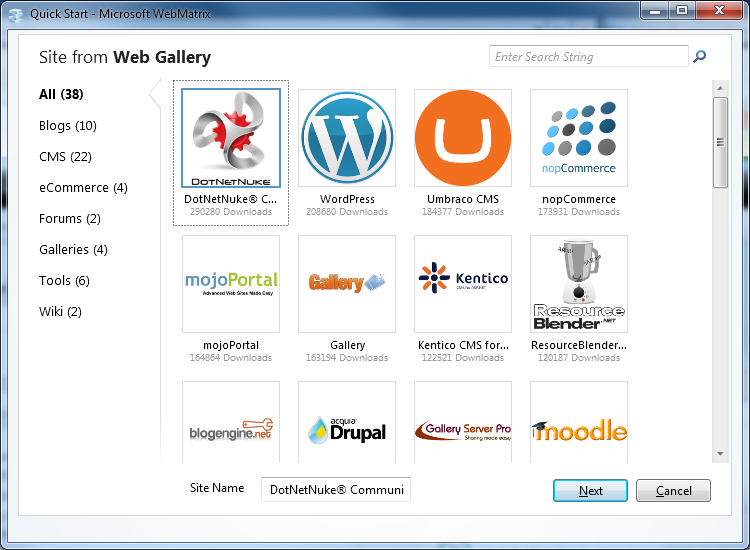
Microsoft has released WebMatrix, a free tool for creating web sites for Microsoft’s web server. It uses the Web Platform Installer and installed smoothly on my Windows 7 64-bit box. What you get is a cleanly-designed tool which lets you start web sites from templates or from standard installs of popular applications including WordPress, Drupal and Moodle.

image

Yes, you can use PHP and MySQL as well as .NET web applications, though the common factor is that all are configured for IIS, Microsoft’s web server.

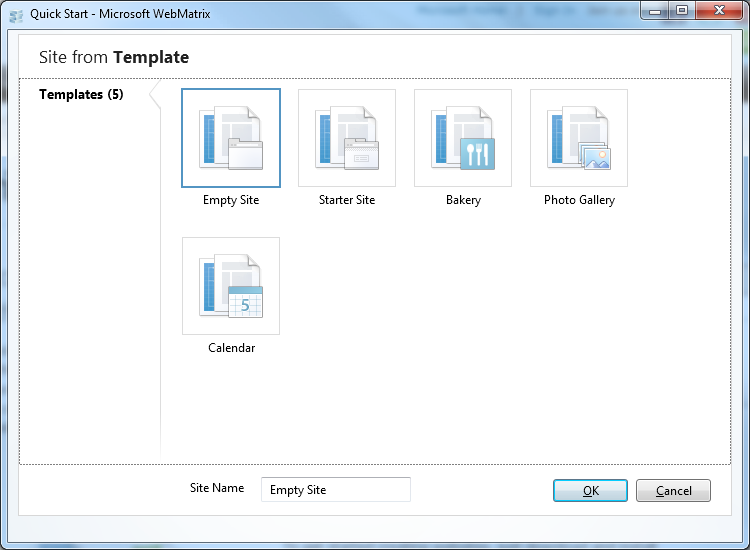
With many ISPs already offering instant installs of apps like WordPress, it is more interesting to look at the site templates in WebMatrix, though the selection is smaller.

image

What is interesting about these is that they create sites based on Razor, an alternative view engine for ASP.NET. Microsoft VP Scott Guthrie describes Razor here. It is odd though: Razor is a feature of ASP.NET MVC 3, currently in release candidate phase, but you cannot create ASP.NET MVC sites in Web Matrix.

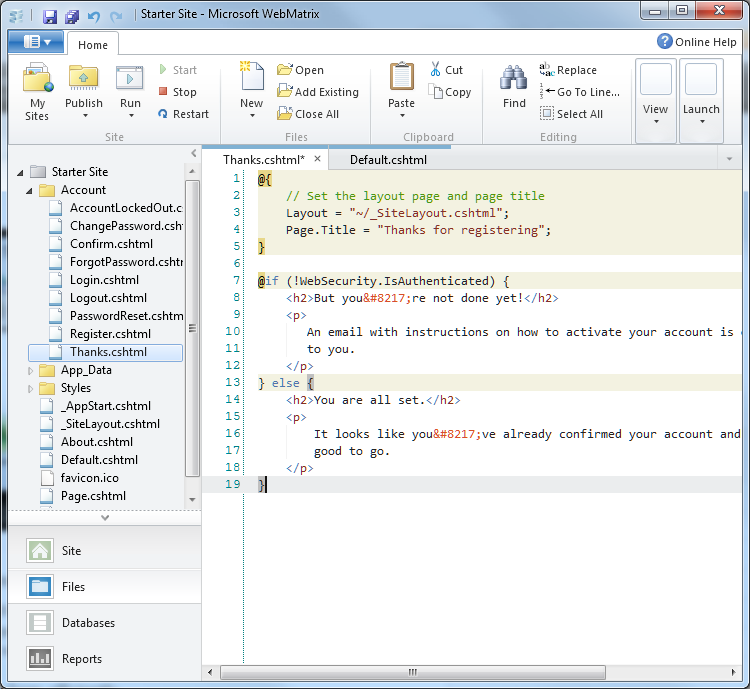
Once a site is created, you can modify it in the WebMatrix editor.

image

You can run the site on IIS Express with one click. WebMatrix will show you all the requests as you run, which could be handy for tracing problems. There is also a database management workspace which uses SQL Server Compact Edition, a reporting workspace which will analyse your site for problems, and the ability to publish a site using  FTP or Microsoft’s Web Deploy.

I like the clean look of WebMatrix, and that it is lightweight and fast; but who is the target user? It appears to be aimed at non-professionals; but this is a techie product that will not appeal to users looking for an easy to use web site builder. There is no visual editor; users are just chucked in at the deep end editing raw HTML and C#. There is not even any intellisense code completion. Clicking Online Help just brings up a Microsoft search form. There is no debugger to speak of; you are expected to upgrade to Visual Studio. Which raises the question, why not just get Visual Web Developer 2010 Express, which is also free, and has a better editor and debugging features? Of course you could use the two together; but Web Matrix is not adding much value. Features like the SEO analysis seem to be be based on the existing Search Engine Optimization Toolkit, which you can install without Web Matrix.

WebMatrix has been available in beta for six months, but its forum is relatively quiet.

Still, if nothing else Web Matrix is a handy way to take a look at Razor, which deserves attention. Shay Friedman has a technical introduction here.

Guthrie has a detailed look at the WebMatrix beta here.

Bob Muglia leaving Microsoft, CEO Steve Ballmer searching for new cloud leadership

Microsoft has announced that Bob Muglia, President of Server and Tools, is leaving Microsoft.

In his memo, Steve Ballmer says:

Bob Muglia and I have been talking about the overall business and what is needed to accelerate our growth. In this context, I have decided that now is the time to put new leadership in place for STB. This is simply recognition that all businesses go through cycles and need new and different talent to manage through those cycles.

It is always hard to tell from the outside, but in my encounters Muglia has been among the most articulate and confident of Microsoft’s top executives. I have also noticed in my regular look at Microsoft’s financials that the Server and Tools business has performed consistently well for as long as I can remember.

Most recently, Muglia took over the Azure business and seemed to know where he was going with it. He is also responsible for developer tools, and while his remarks about Silverlight at Microsoft’s PDC in November were disappointing to developers on that platform, they showed a clear sense of direction.

In this context, it seems surprising that Ballmer is in search of “new and different talent”. It does sound as if Ballmer and Muglia do not see the future of the cloud business – which is the focus of the memo – in the same way.

The key question: in what way did Ballmer and Muglia’s vision differ? I guess we will get some more clues as today’s news is discussed.

Update: Mary Jo Foley has posted Bob Muglia’s internal email to his team:

Later this year, I’m moving on to new opportunities outside of Microsoft, so I wanted to take a few minutes to share with you what’s important to me in life and leadership.

The foundation of who I am is based on living with integrity. Integrity requires principles, and my primary principle is to focus on doing the right thing, as best I can. The best thing, to the best of my ability, for our customers, our products, our shareholders, and of course, our people.

Just sugar, or did Muglia feel that staying at Microsoft would compromise those principles?

Since the announcement, the reaction across the industry has shown the high regard in which he is held, and bewilderment at why he is being let go. Here’s Redmonk analyst James Governor on Twitter:

Another exit: Microsoft server chief Muglia leaving company normally i say so what but this is TERRIBLE for microsoft

Apple’s Mac App Store – and the forgotten Windows Marketplace

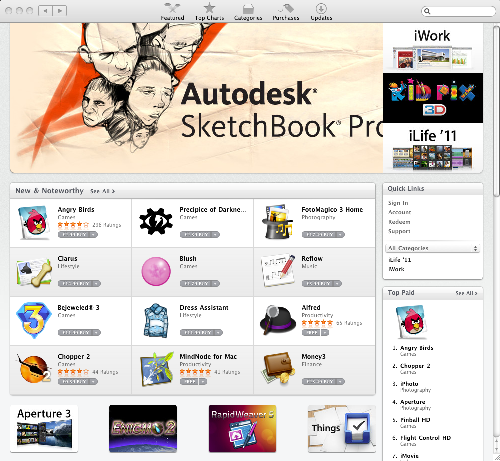
Apple launched the Mac App Store yesterday and I had a look this morning. It is only available to users of Mac OS X Snow Leopard, where it comes with the latest system update.

image

It is interesting that Apple has not used iTunes for the App Store, but has developed new client software. Maybe it is coming round to opinion that iTunes has become bloated; it is only for historic reasons that a music player has become an all-purpose app installer.

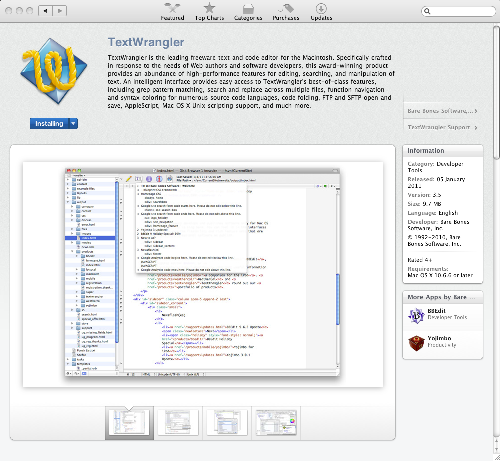
The store itself worked well for me. I picked a free app, TextWrangler, and signed in with my Apple ID. The UI showed Installing, then Installed, and I was done.

image

The TextWrangler icon appeared in the Dock so I could start the app easily.

What counts is what I did not have to do – reboot, select from setup options, or deal with perplexing error messages.

Users will also like the common-sense licensing, which lets you download and install a purchased app on any Mac you use, controlled by your App Store log-in. I am not sure what happens if you install your app on your friend’s Mac, then sign out of the App Store. There is some link between the app and your Apple ID, because if you copy the application to another Mac it will ask for your sign-in details when you first run it, but I am not clear whether this is checked on every run to deter piracy.

Most important, there is an attractive range of apps at good prices. In the UK, Angry Birds is £2.99, Pinball HD £1.79, and Apple Pages or Keynote £11.99 each. That is less than typical Apple Store shrink-wrap prices. The prices for Pages and Keynote makes the price Microsoft charges for Office look impossibly expensive. Good for customers; but worrying for independent software vendors who want to make a living.

Developers pay $99.00 per year to join the Mac Developer Program and then 30% commission to Apple on every sale. Of course, like the iPhone App Store, apps are subject to Apple’s approval.

Lest you think it is clever of Apple to invent an app store for the desktop, it is worth noting that the concept is an old one. Linux has delivered free software like this for years, and some distributions have also featured paid app installers integrated into the OS.

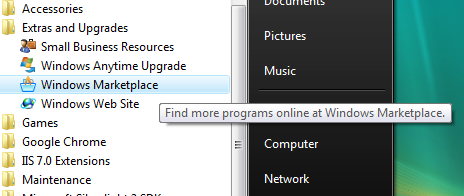
So has Microsoft, which has run various varieties of Windows Marketplace over the years, for mobile and desktop applications. Windows Vista shipped with an app store for both Microsoft and third-party apps built-in. It was on the Start menu:

image

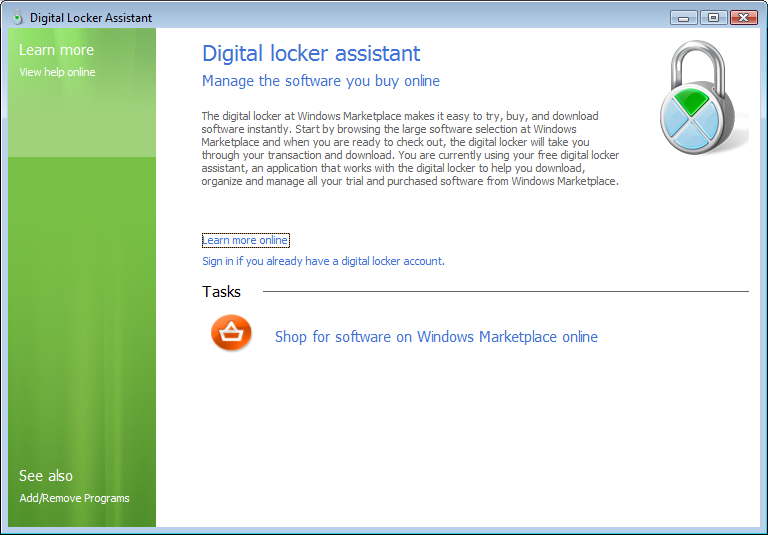
as well as in Control Panel:

image

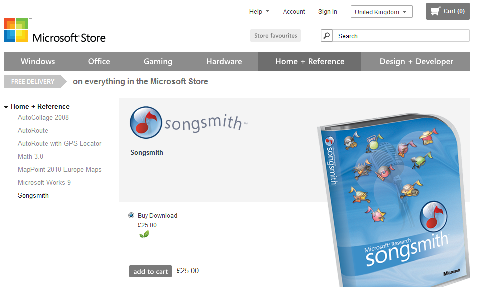
On November 1st 2008 Microsoft shut down Windows Marketplace and “transitioned” it to a referral site. There was some angst at the time about the closing of the digital locker, which proved insecure against the threat of corporate mind-changing. It still runs the online Microsoft Store, but this is for Microsoft-only products. For example, you can download Microsoft Songsmith for £25.00:

image

Why did Windows Marketplace fail? Well, the user experience was poor, it was insufficiently prominent in the Vista user interface, setup could be troublesome. Major Windows app vendors figured out that they would be better off drawing potential customers to their own web sites, where they have full control. As is often the case, Microsoft was conflicted over whether it wanted to drive customers to the online store, or to partner retailers, or to app vendor sites; and the OEMs would have their say as well, when customising Windows for their own PCs.

Another factor is that Windows apps are often not well isolated. Silverlight actually solves this problem – out-of-browser apps are well isolated and secure – but Microsoft does not even ship Silverlight by default with Windows.

The indications are that Microsoft will have another go in Windows 8. Documents leaked last year show an app store. From my post at the time:

There’s a pattern here. Microsoft gets bright idea – Tablet, Windows Marketplace, Passport. Does half-baked implementation which flops. Apple or Google works out how to do it right. Microsoft copies them.

NVIDIA Tegra 2: amazing mobile power that hints at the future of client computing

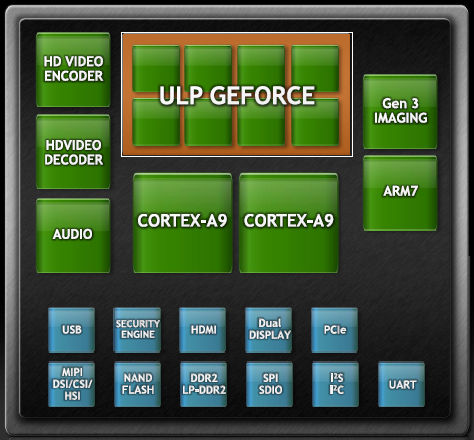
Smartphone power has made another jump forward with the announcement at CES in Las Vegas of new devices built on NVIDIA’s new Tegra 2 package – a System on a Chip (SoC) that includes dual-core CPU, GPU, and additional support for HD video encoding and decoding, audio, imaging, USB, PCIe and more:

image

The CPU is the ARM Cortex-A9 which has a RISC (Reduced Instruction Set Computer) architecture and a 32-bit instruction set. It also supports the Thumb-2 instruction set which is actually 16-bit. How is 16-bit an upgrade over 32-bit? Well, 16-bit instructions means smaller code, even though it gets translated to 32-bit instructions at runtime:

For performance optimised code Thumb-2 technology uses 31 percent less memory to reduce system cost, while providing up to 38 percent higher performance than existing high density code, which can be used to prolong battery-life or to enrich the product feature set.

The GPU is an “ultra low power” (ULP) 8-core GeForce. In essence, the package aims for high performance with low power consumption, exactly what is wanted for mobile computing.

Power is also saved by sophisticated power management features. The package uses a combination of suspending parts of the system, gating the clock speed, screen management, and dynamically adjusting voltage and frequency, in order to save power. The result is a system which NVIDIA claims is 25-50 times more efficient than a typical PC.

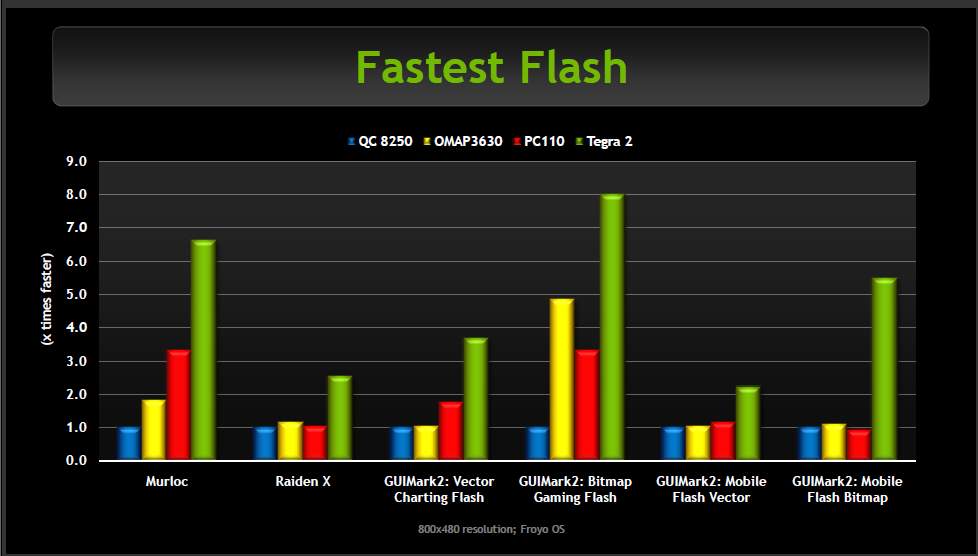
According to NVIDIA, Tegra 2 enables web browsing up to two times faster than competitors such as the Qualcomm Snapdragon 8250 or Texas Instruments OMAP 3630 – though of course these companies also have new SoCs in preparation.

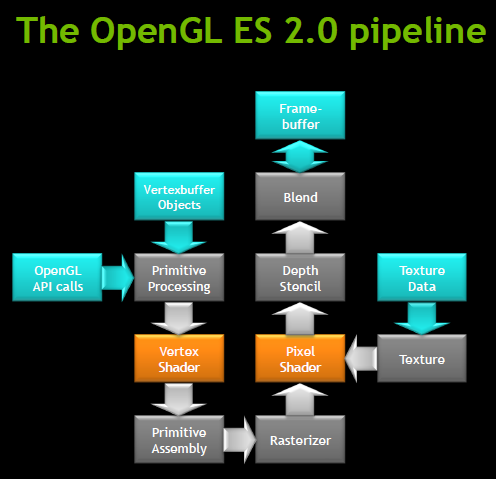
Tegra 2 is optimised for some specific software. One is the OpenGL graphics API. “The job of the GPU is to implement the logical pipeline defined by OpenGL”, I was told at an NVIDIA briefing.

image

I asked whether this meant that Tegra 2 is sub-optimal for Microsoft’s Direct X API; but NVIDIA says it is sufficiently similar that it makes no difference.

Nevertheless, Tegra 2 has been designed with Android in mind, not Windows. There are a couple of reasons for this. The main one is that Android has all the momentum in the market; but apart from that, Microsoft partnered with Qualcomm for Windows Phone 7, which runs on Snapdragon, shutting out NVIDIA at the initial launch. NVIDIA is a long-term Microsoft partner and the shift from Windows Mobile to Android has apparently cost NVIDIA a lot of time. The shift took place around 18 months ago, when NVIDIA saw how the market was moving. That shift “cost us a year to a year and a half of products to market”, I was told – a delay which must include changes at every level from hardware optimisation, to designing the kind of package that suits the devices Android vendors want to build, to building up knowledge of Android in order to market effectively to hardware vendors.

Despite this focus, Microsoft demonstrated Windows 8 running on Tegra during Steve Ballmer’s keynote, so this should not be taken to mean that Windows or Windows CE will not run. I still found it interesting to hear this example of how deeply the industry has moved away from Microsoft’s mobile platform.

Microsoft should worry. NVIDIA foresees that “all of your computing needs are ultimately going to be surfaced through your mobile device”. Tegra 2 is a step along the way, since HDMI support is built-in, enabling high resolution displays. If you want to do desktop computing, you sit down at your desk, pop your mobile into a dock, and get on with your work or play using a large screen and a keyboard. It seems plausible to me.

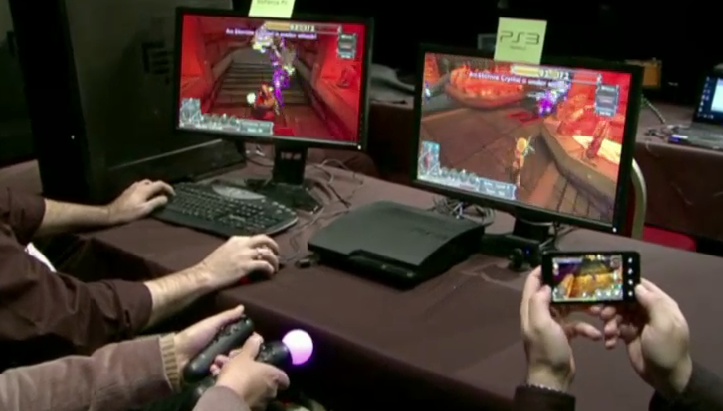
During the press conference at CES we were shown an example of simultaneous rich graphic gaming on PC, PlayStation 3, and Tegra 2 Smartphone.

image

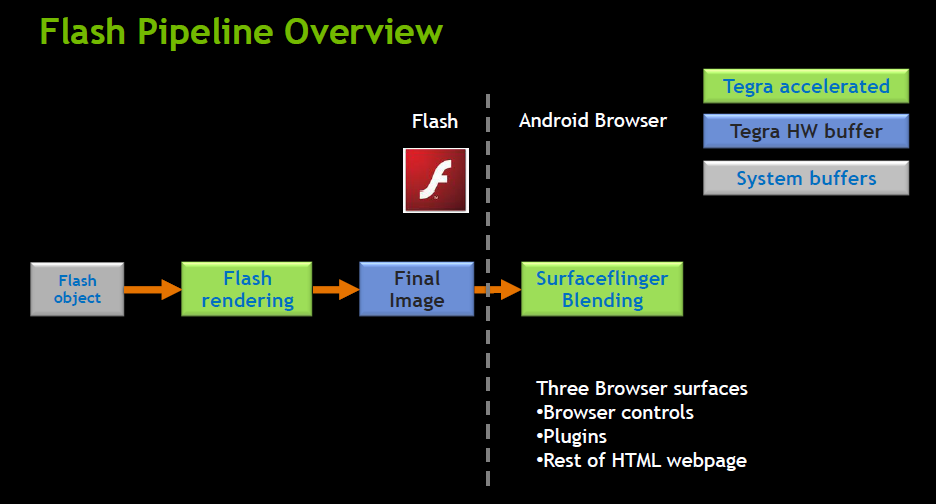
Alongside Android, Tegra 2 is optimised for Adobe Flash. NVIDIA has been given full access to the source of the Flash player in order to deliver hardware acceleration.

image

image

Actual devices

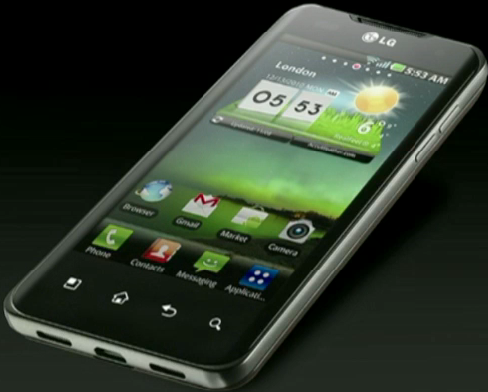
What about actual devices? Two that were shown at CES are the LG Optimus 2X:

image

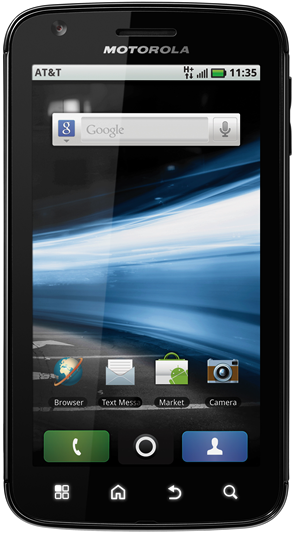
and the Motorola Atrix 4G:

image

Both sport impressive specifications; though the Guardian’s Charles Arthur, who attended a briefing on the Atrix 4G, expresses some scepticism about whether HD video (which needs a large display) and the full desktop version of FireFox are really necessary on a phone. Apparently the claimed battery life is only 8 hours; some of us might be willing to sacrifice a degree of that capability for a longer battery life.

Still, while some manufacturers will get the balance between cost, features, size and battery life wrong, history tells that we will find good ways to use these all this new processing and graphics power, especially if we can get to the point where such a device, combined with cloud computing and a desktop dock, becomes the only client most of us need.

NVIDIA says that over 50 Android/Tegra 2 products are set to be released by mid-2011, in tablet as well as Smartphone form factors. I’m guessing that at least some of these will be winners.

Steve Ballmer at CES: Microsoft pins mobile hopes on Windows 8

Microsoft CEO Steve Ballmer gave the keynote at CES in Las Vegas last night. It was a polished performance and everything worked, but was short on vision or any immediate answer to the twin forces of Apple iPad and Google Android which are squeezing out Microsoft in the mobile world – smartphones and tablets – which currently forms the centre of attention in personal computing.

That said, CES stands for Consumer Electronics Show; and Ballmer did a good job showing off how well Kinect is performing, claiming sales of 8 million already. He showed more examples of controlling Xbox through speech and gesture, and said that Kinect is also boosting sales of the console; clearly it is now taking it beyond the hardcore market of first-person shooters.

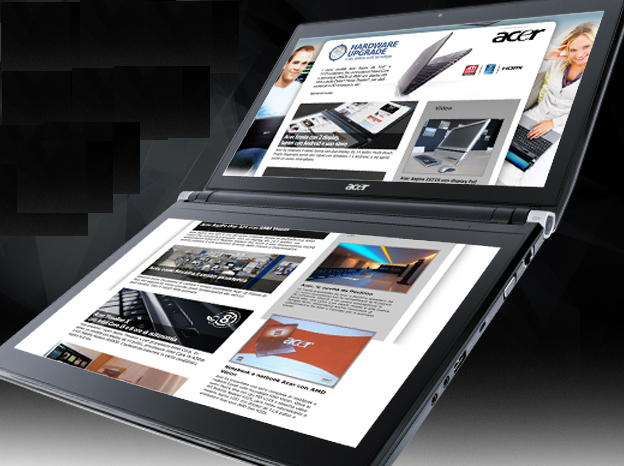
We saw some fun new Windows devices, such as Acer’s dual-screen Iconia laptop.

image

There was also a demonstration of the updated Microsoft Surface which now runs full Windows 7 and does not require hidden cameras, so that it can now be used in more scenarios, such as for interactive digital signage.

All well and good; but what about mobile? We got a Windows Phone 7 demo, but no sales figures, nor any mobile partners on stage; I’m guessing they are too busy promoting their new Android devices. Ballmer did say that the phone is coming on Verizon and Sprint in the first half of this year. Application availability is improving, but how will Microsoft win attention for its smartphone? My local high street is full of mobile phone shops, none of which even stock it as far as I can tell. There is a tie-in with Xbox Live which may help a little.

The problem though is that Microsoft does not seem to be wholeheartedly behind the Windows Phone 7 OS, which is based on Windows CE with a new GUI and Silverlight/XNA runtime for applications. Rather, Microsoft is signalling that full Windows is its future mobile operating system. At CES it announced Windows on ARM, the processor of choice in mobile, and during the keynote we saw the next version of Windows (though with the Windows 7 GUI) running on various ARM devices.

The power available in new System on a Chip packages like NVIDIA’s Tegra 2 leaves me in no doubt that full Windows could technically run on almost any size of device; but that does not make it the sensible choice for all form factors. Note also that while it was not mentioned at CES, NVIDIA has said that Tegra 2 is optimized for Android.

Microsoft could plausibly have released a tablet based on the Windows Phone 7 OS, which is built for touch control, this year. Instead, it will be at least 2012 before we see a Windows 8 tablet, and we are taking it on trust that this will really work nicely with touch and not need a stylus dangling at the side. By then Apple will, I presume, be releasing iPad generation 3.

Putting this in a developer context, what is Microsoft’s mobile development platform? Silverlight and XNA? The full Windows native API? Or HTML 5? Each of these is very different and it seems to me a muddled story.

NVIDIA’s first CPU, Project Denver, aims to bring ARM to desktops and servers

At CES in Las Vegas today NVIDIA’s CEO Jen-Hsun Huang announced the company’s first CPU: Project Denver. This is a partnership with ARM, to create “a full custom processor” targeting “high performance computing – servers, PCs, super-computers, cloud computing.” NVIDIA will still licence ARM processors for mobile computing.

Since ARM has in the past focused on the mobile and embedded market, and NVIDIA on GPUs, it is a departure for both companies.

Why? Huang says it is because ARM is “the new standard microprocessor architecture.” Judging by this chart, shown at the press briefing, it is hard to disagree:

image

In a few years, said Huang, “There will be more ARM processors shipped than all the x86 chips ever shipped.”

image

NVIDIA’s press release explains that the purpose of Project Denver is to extend the range of ARM systems upwards:

For several years, makers of high-end computing platforms have had no choice about instruction-set architecture.  The only option was the x86 instruction set with variable-length instructions, a small register set, and other features that interfered with modern compiler optimizations, required a larger area for instruction decoding, and substantially reduced energy efficiency.

Denver provides a choice.   System builders can now choose a high-performance processor based on a RISC instruction set with modern features such as fixed-width instructions, predication, and a large general register file.   These features enable advanced compiler techniques and simplify implementation, ultimately leading to higher performance and a more energy-efficient processor.

The other interesting aspect of Project Denver is its integration with the GPU – as you would expect from NVIDIA:

An ARM processor coupled with an NVIDIA GPU represents the computing platform of the future.  A high-performance CPU with a standard instruction set will run the serial parts of applications and provide compatibility while a highly-parallel, highly-efficient GPU will run the parallel portions of programs.

While we tend to focus most on power efficiency for mobile devices, because we notice how long our batteries last, it is equally important for larger systems. Power consumption and dealing with heat is a key issue for datacentres, while in everyday desktop computing power consumption is a significant proportion of the running cost of an IT system.

Project Denver puts a different spin on Microsoft’s Windows-on-ARM announcement today. The assumption is that Microsoft has in mind a mobile future for Windows; but if Denver takes off it could be important on desktops and servers as well.

Before getting too excited, it is worth recalling how Intel’s Itanium, cruelly dubbed the Itanic, mostly failed in the market. That was partly thanks to design problems, and partly because the industry was too deeply hooked into x86 applications. I also recall Motorola’s doomed attempts to sell Windows NT on PowerPC in the mid Nineties.

Denver could fare better, thanks to the ubiquity of ARM in the mobile world. That said, much will depend on whether a Denver-based system really does offer significant benefits over whatever Intel and/or AMD will have come up with by the time it ships. If it is less than spectacular, Denver will be a hard sell.